General Information
Project Type
| Structure: |
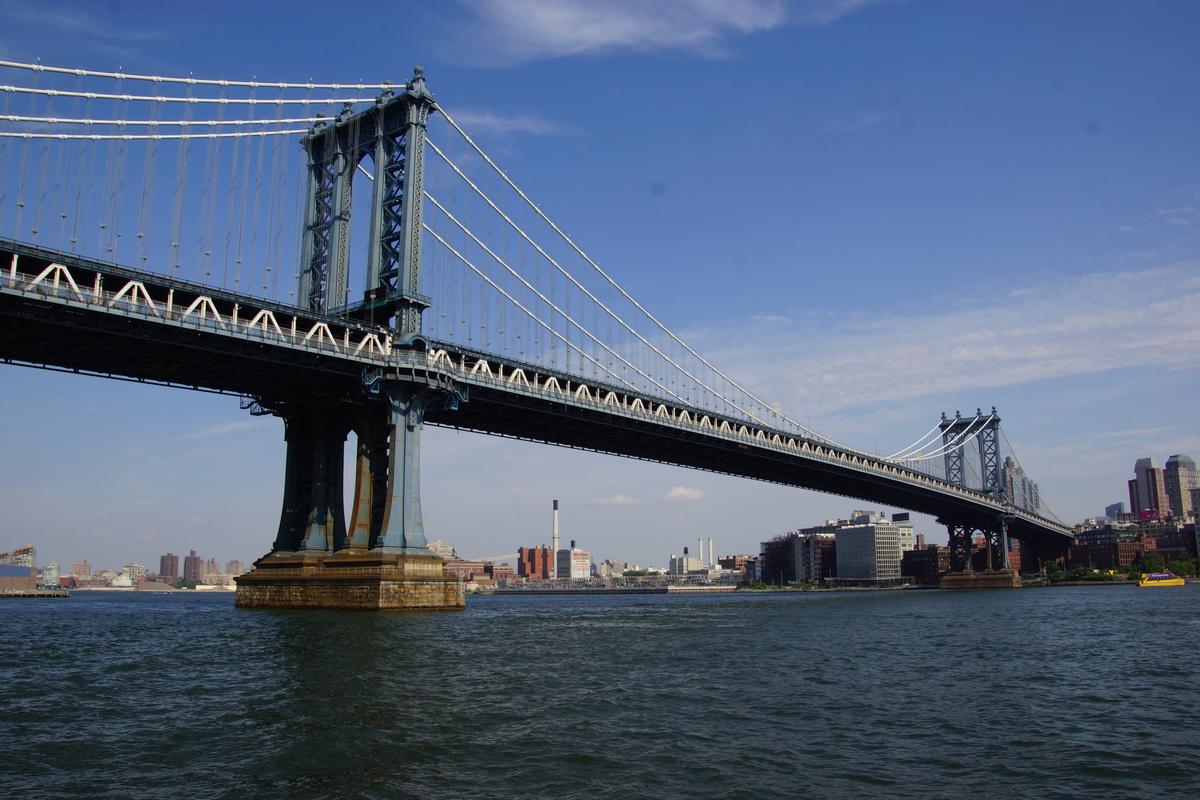
Three-span suspension bridge |
|---|---|
| Support conditions: |
for registered users |
| Secondary structure(s): |
Structurae Plus/Pro - Subscribe Now! |
| Function / usage: |
upper deck: Road bridge lower deck: Tramway, light or metro rail bridge |
| Material: |
Steel bridge Structurae Plus/Pro - Subscribe Now! |
Awards and Distinctions
| 2009 |
for registered users |
|---|
Location
| Location: |
Manhattan, New York, New York, USA Brooklyn, New York, New York, USA |
|---|---|
| Crosses: |
|
| Next to: |
Brooklyn Bridge (1883)
|
| Coordinates: | 40° 42' 23.77" N 73° 59' 25.08" W |
Technical Information
Dimensions
| main span | 448.1 m | |
| total length | 2 089 m | |
| height above valley floor or water | 41.1 m | |
| cables | number of cables | 4 |
| strands per cable | 37 | |
| wires per strand | 256 | |
| cable diameter | 53.975 cm | |
| total number of wires per cable | 9 472 | |
| deck | deck depth | 7.3 m |
| deck width | 36.6 m | |
| pylons | height | 102.4 m |
| main bridge | ||
|---|---|---|
| span lengths | 221.0 m - 448.1 m - 221.0 m | |
| number of spans | 3 | |
Cost
| cost of construction | United States dollar 31 084 705.00 |
Materials
| cables |
steel
|
|---|---|
| deck |
steel
|
| foundations |
masonry
|
| pylons |
steel
|
| anchorages |
masonry
|
Chronology
| 1 October 1901 | Construction begins. |
|---|---|
| 1 August 1908 | Construction of the main cable begins. |
| 10 December 1908 | Main cable construction completed. |
| 31 December 1909 | Using wooden planks placed on the stringers, the bridge is first opened, although it is not yet completed. |
| 1912 | Completion of the bridge. |
Notes
Manhattan bridge was the first, bridge to have a 21-inch diameter main cable, largest at that time. It is still the strongest of the four east river bridges. The bridge originally was going to be a parallel wire cable suspension bridge, then an eyebar and chain type bridge, then finally reverted back to a parallel-wire cable suspension bridge. Both upper roadways of the bridge originally had [4] tracks for street cars [trolleys]. As time progressed, the tracks were removed to convert the roadways for vehicular traffic.
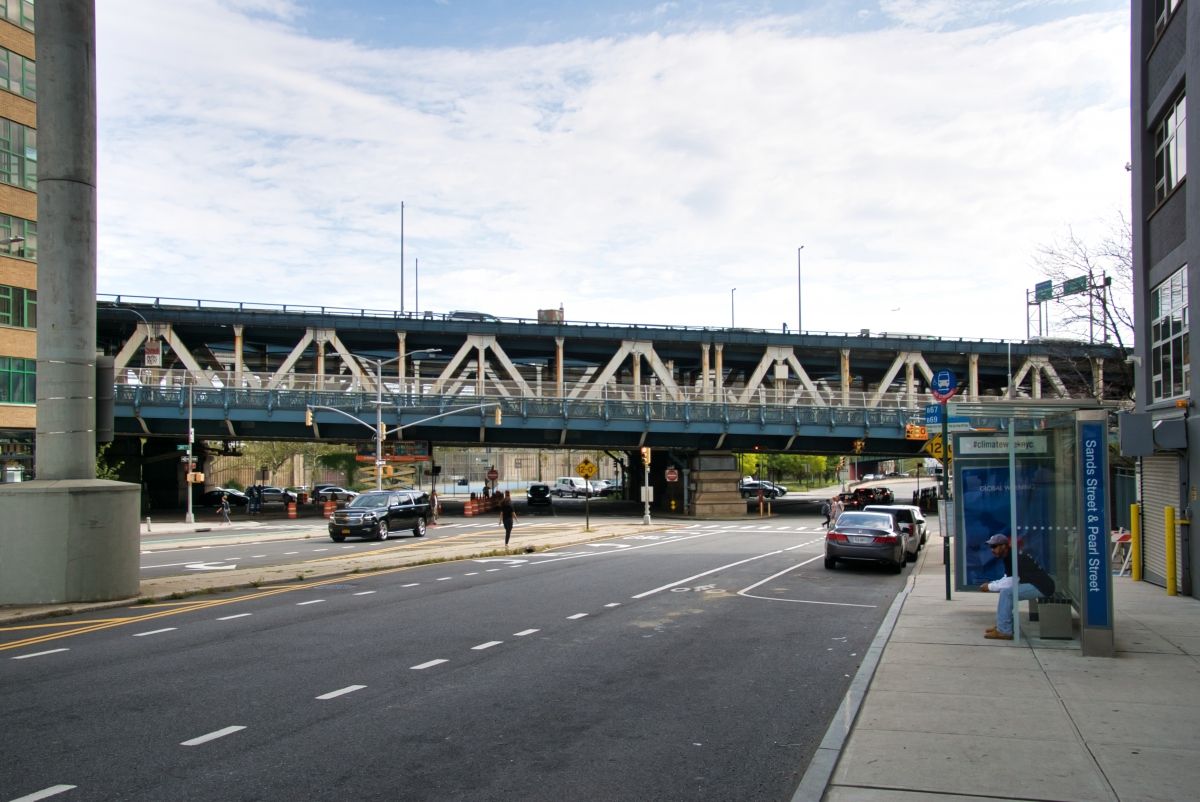
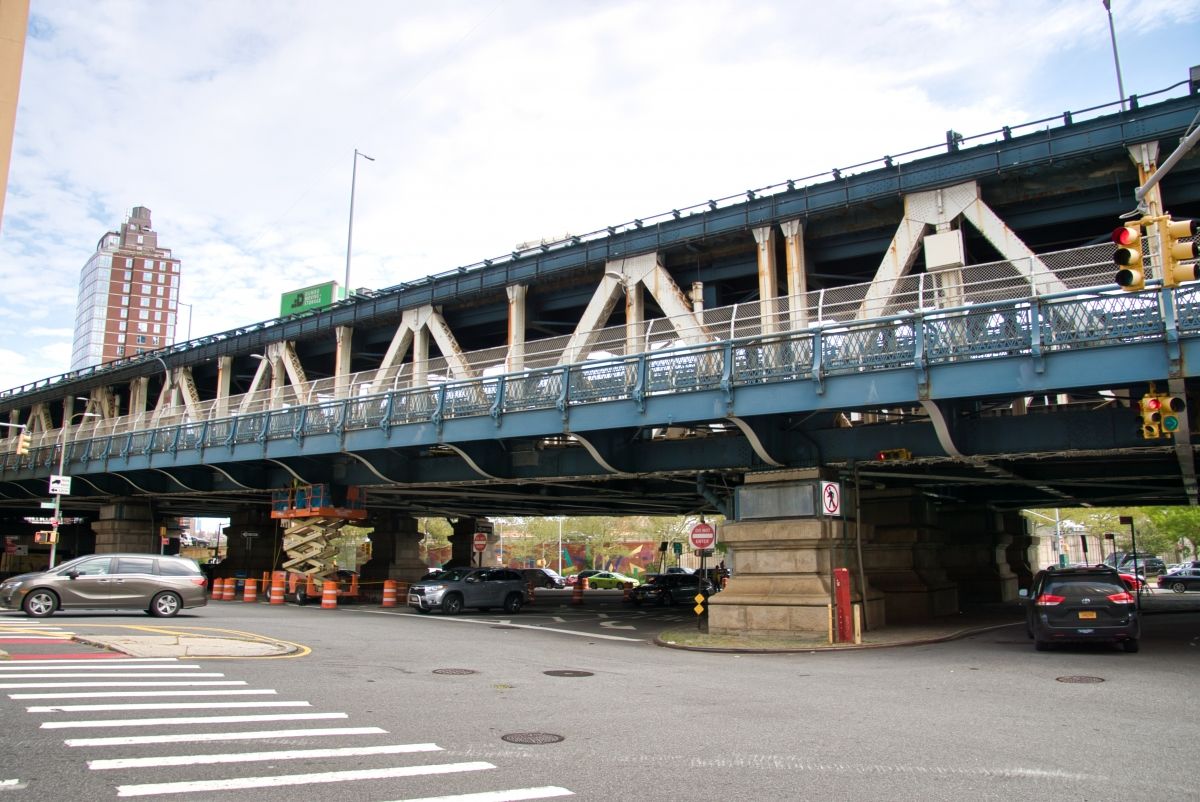
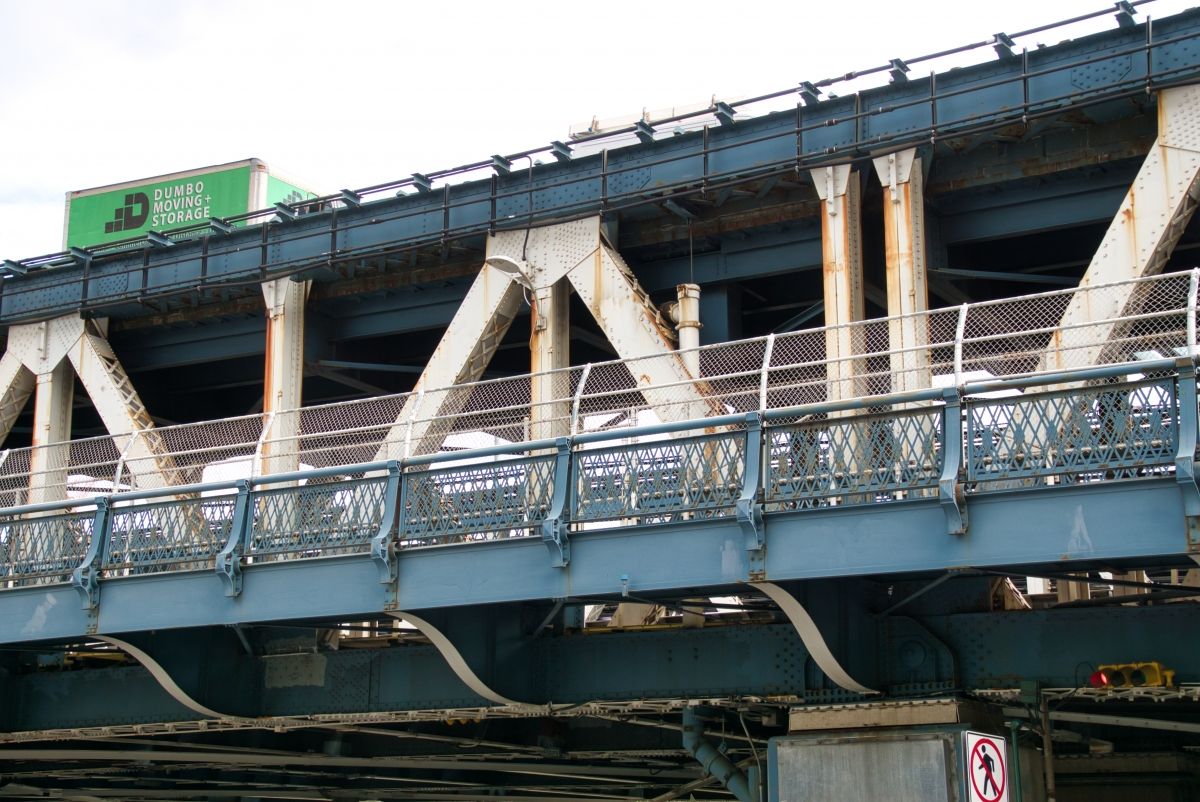
Manhattan bridge was the first suspension bridge to use flexible steel towers, unlike some other bridges such as the Williamsburg and the George Washington that used braced steel towers. The Manhattan bridge was the first modern steel suspension bridge to use a Warren type stiffening truss. It was the first modern steel suspension bridge to use two suspender ropes straddled over the main cables to attach to the floor beams.
Decorative spheres on top of the towers serve no function. Below them rest the saddles for the main cables. Leon Moisseiff was also advisory engineer of design of the Great George Washington Bridge. [Text contributed by Dave Frieder]
Participants
Initial construction (1901-1912)
Design
- Othniel Foster Nichols (chief engineer)
- Leffert Lefferts Buck (chief engineer)
- Samuel R. Probasco (chief engineer)
- Colin M. Ingersoll (chief engineer)
- Alexander Johnson (chief engineer)
- Henry A. La Chicotte (deputy chief engineer)
- Leon Solomon Moisseiff (assistant design engineer)
- Daniel J. Maloney (assistant design engineer)
- Guy L. Vroman (assistant design engineer)
- Clarence L. Carman (assistant design engineer)
- Holton Duncan Robinson (assistant design engineer)
- Robert E. Hawley (assistant design engineer)
Architecture
-
Carrère and Hastings
- John Merven Carrère (architect)
- Thomas Hastings (architect)
Consulting engineers
- Richard S. Buck (consulting engineer)
Steel construction

Resident engineering
- David B. Baxter (assistant resident engineer)
- Frank M. Sylvester (assistant resident engineer)
- John A. Knighton (assistant resident engineer)
- W. Radford Bascome (assistant resident engineer)
- Joseph R. Geoghan (assistant resident engineer)
- Robert R. Crowell (assistant resident engineer)
- John H. Weinberger (assistant resident engineer)
- Noah Cummings (assistant resident engineer)
- George S. G. Lewis (assistant resident engineer)
Cables
Rehabilitation
Engineering
- Herb Rothman (engineer)
Monitoring
Monitoring equipment
Relevant Web Sites

Relevant Publications
- (2006): Advances in Cable-Supported Bridges. Taylor & Francis, Abingdon-on-Thames (United Kingdom), pp. 261.
- Bids for the Manhattan Bridge. In: Scientific American, v. 93, n. 8 (19 August 1905), pp. 134.
- (2000): The Bridges of New York. Dover Publications Inc., Mineola (USA), pp. 40-57.
- (1995): Cable anchorage repairs on New York City suspension bridges. Presented at: IABSE Symposium: Extending the Lifespan of Structures, San Francisco, CA, USA, August 1995, pp. 513-518.
- Chains Versus Cables in the Manhattan Bridge. In: Scientific American, v. 93, n. 14 (30 September 1905), pp. 254.
- About this
data sheet - Structure-ID
20000529 - Published on:
20/11/1999 - Last updated on:
01/10/2019
Structurae cooperates with